
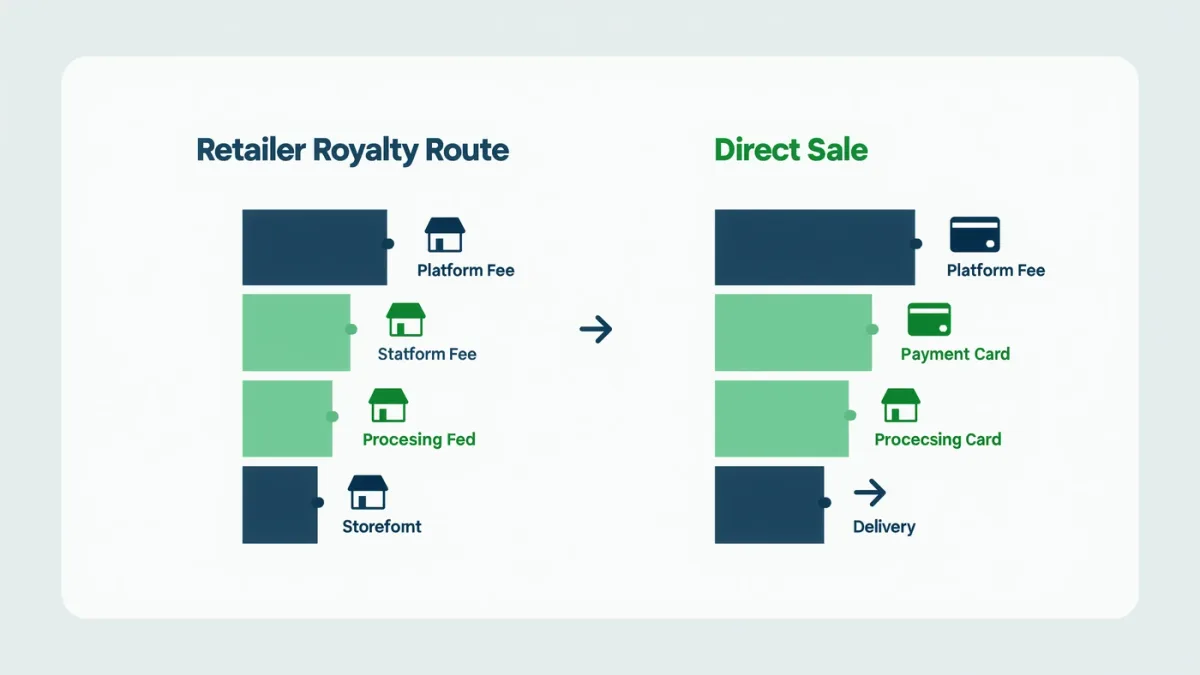
Yes — with a storefront service like Payhip, Gumroad, or Shopify plus a delivery tool such as BookFunnel, you can sell ebooks from your own site today, keep roughly 90 to 95 percent of each sale after platform and card fees (Payhip's free tier, per its published pricing, takes 5 percent; Gumroad's published fee schedule has run around 10 percent plus processing), and own the customer email list no retailer shares with you.
MonBook Pro publishes information, not financial advice — fee schedules change, so verify current rates on each platform's pricing page before committing.
Why Sell Direct at All?
Three reasons that compound. Margin: retailer royalties of 70 percent become 90-plus percent direct. Data: the buyer's email address is yours — the most valuable marketing asset in publishing, and something no store's terms give you. Control: you can bundle, discount, or attach bonus content at will, run your own launch pricing, and sell formats stores do not carry, like annotated editions or DRM-free files for readers who resell or gift copies. The trade-off is that every sale is traffic you generate yourself; a website with no audience sells nothing.
What Are the Moving Parts of a Direct Store?
- Storefront: Payhip, Gumroad, Shopify, or a WooCommerce installation on your own hosting — the page that lists the product and takes the order.
- Payment processing: Stripe and PayPal are the standard backends; card processing typically costs around 2 to 3 percent plus a small fixed fee per transaction, per Stripe's published US pricing.
- File delivery: BookFunnel is the industry default — it delivers EPUB, MOBI, and PDF to any device with guided side-loading help, replacing the retailer's sync infrastructure. Delivery via plain download links also works but generates support email.
- Tax handling: digital goods VAT, which the EU applies to ebooks and which many jurisdictions collect — pick a platform that acts as merchant of record or handles VAT calculation, or this becomes your problem at tax time.
Which Platform Fits Which Author?
Payhip suits beginners: free tier, percentage fee, built-in VAT handling for many regions, simple product pages. Gumroad suits authors selling multiple digital products — courses, bookmarks, ebooks — with polished checkout pages and a built-in audience discovery layer. Shopify suits authors operating a real direct business with merch and print, at a monthly subscription plus app fees rather than a pure percentage. WooCommerce is the sovereign option: your hosting, your fees, your maintenance burden. Start simple; migrating a customer list later is easier than maintaining an empire on day one.
| Platform | Cost model | Best for |
|---|---|---|
| Payhip | free tier, ~5% fee | first direct sales, simplicity |
| Gumroad | ~10% + processing | multi-product creators |
| Shopify | monthly + apps | scaling direct business |
| WooCommerce | hosting + your time | full control, technical authors |
What About VAT and Sales Tax?
This is the part that surprises everyone. Digital goods including ebooks are subject to VAT in the EU — historically at reduced rates for books in most member states, though the collection rules for cross-border digital sales since 2015 require sellers to account for the buyer's country. Platforms acting as merchant of record absorb this; raw Stripe checkouts do not. In the US, states tax digital goods inconsistently. The safe pattern for a non-expert: choose a storefront that calculates and remits tax for you, and confirm on the platform's own documentation rather than forum advice.
How Do Buyers Actually Get the File?
Through BookFunnel in most indie setups: the customer pays on your storefront, receives a download link, and BookFunnel's delivery pages walk them through loading the file onto a Kindle, Kobo, or reading app — the support burden that kills direct sales is exactly what the service exists to carry. Per its published feature pages, delivery integrates with the major direct-sales platforms. Readers increasingly expect this: the indie direct-sales niche normalized it through the 2020s.
What Should Your Direct Store Actually Stock on Day One?
Start with what retailers cannot offer, not what they already sell well. The dependable direct sellers are the DRM-free ebook of your newest release bundled with bonus content, signed print editions, complete box sets at a bundle-plus price, and early access — a week or two before the retailer release — for your newsletter list. Give buyers a reason to choose your checkout over a one-click store purchase, because convenience favors the retailer and only uniqueness favors you. Add a simple two-line refund policy and a contact address; trust signals convert on author sites far more than design polish does.
Does Selling Direct Mean Leaving Retailers?
No, and almost nobody does. The standard architecture is hybrid: retailers for discovery and Kindle Unlimited readers, your site for the fans your newsletter already reaches — where the higher margin and the email capture pay off on exactly the readers who cost you nothing to acquire. Just respect KDP Select's exclusivity terms if you enroll: per Amazon's terms page, a Select-enrolled ebook cannot also be sold from your own site.
For more context, read How Do Indie Ebook Royalties Actually Work?.
For more context, read publish to apple books.
For more context, read box sets indie authors.