
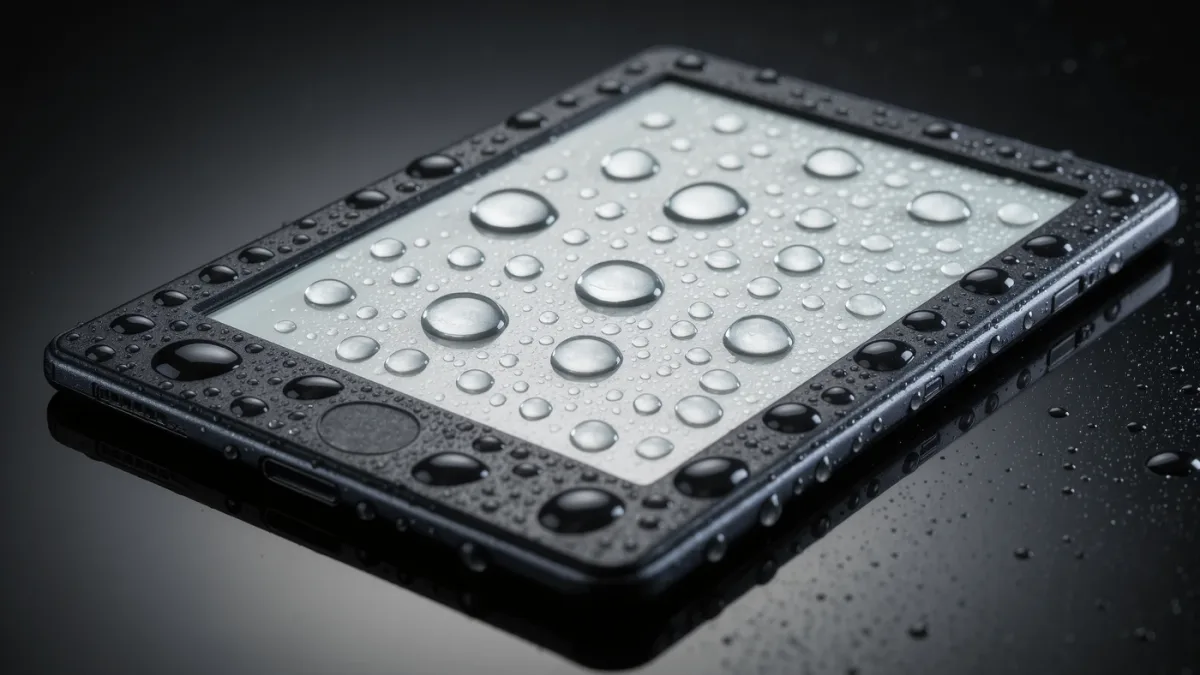
IPX8 on an e-reader's spec sheet means the manufacturer tested the device for continuous submersion in fresh water — typically, per makers' own footnotes, up to one meter for up to 60 minutes in clean water. So yes, a Kindle Paperwhite or Kobo Libra rated IPX8 can survive a drop into the bath or pool, and no, it does not make the reader immune to chlorine, salt water, soap, or pressurized jets. That gap between the rating and the marketing is where most drowned readers come from.
MonBook Pro publishes information, not warranty advice — dunking consequences are between you and the manufacturer's warranty terms.
Where does the IPX8 rating come from?
From IEC standard 60529, the international classification scheme for ingress protection. The first digit rates protection against solids (dust), the second against liquids; the X in IPX8 means the maker did not certify a solids rating. An 8 on the liquids scale — the top of the standard's continuous-immersion grades — means the enclosure survived immersion under conditions the manufacturer specifies. The key phrase is the manufacturer specifies: the standard lets each maker define depth and duration, which is why Amazon's Kindle pages state submersion conditions in fine print and Kobo does the same for its IPX8-rated readers. The standard itself is published by the International Electrotechnical Commission, and its plain-language summaries are available from national standards bodies.
Which e-readers carry the rating?
As of February 2026, per the makers' spec pages: Amazon's Kindle Paperwhite and Scribe lines are IPX8-rated, while the base Kindle and Kindle ColorSoft are not — Amazon lists water resistance per model. Kobo's Libra and Sage families carry IPX8. PocketBook's Era and several 2024–2025 models list IPX8 on their spec sheets. Onyx Boox's plastic-and-glass slates generally do not advertise a rating at all. Check the exact model's page before you buy; ratings vary within a brand's lineup and can change between generations.
| Reader family | Water rating (per maker) | Stated conditions |
|---|---|---|
| Kindle Paperwhite / Scribe | IPX8 | Submersion in fresh water, maker's footnote conditions |
| Kobo Libra / Sage | IPX8 | Fresh-water immersion per Kobo's spec page |
| PocketBook Era | IPX8 | Immersion per PocketBook's documentation |
| Onyx Boox (most models) | Not rated | No ingress-protection claim published |
Can you actually read in the bath or by the pool?
Bath: yes, with basic care — the rating covers accidental submersion in fresh water, and a reader resting on the tub's edge is well within it. Pool: yes for splashes and a brief dunk, but the makers' own fine print usually excludes chlorine damage over time, and neither Amazon's nor Kobo's published conditions cover salt water. Beach readers take note: sea water is the classic exclusion. Two more honest limits from the manufacturers' pages — the rating applies with ports and covers closed and intact, and it does not cover steam or pressurized water, which rules out reading in a hot shower with the spray hitting the device.
How is the submersion test actually performed?
Under IEC 60529, an IPX8 device is immersed in water under conditions the manufacturer defines — depth, duration, and water composition — and must come out functioning. That flexibility surprises people: two readers both rated IPX8 may have been tested at different depths, because the standard grades the enclosure design rather than a single universal scenario. Makers sometimes publish the exact conditions in product footnotes; Amazon's Kindle pages, for instance, have described immersion in fresh water for set periods, and you should read those footnotes rather than the bullet-point "waterproof" claim on the box. What the test does not include: moving water, water jets (that is IPX6 territory), temperature shock, or any liquid other than clean water unless the maker says otherwise. It is a laboratory pass/fail, performed on new units with intact seals — not a simulation of your third summer at the beach. Age, drops that flex the casing, and third-party covers that stress the port seals all sit outside the certificate, which is why a two-year-old reader deserves more caution than a new one.
What should you do if your IPX8 reader goes under?
- Fish it out and power it off — don't keep reading to "check if it's fine."
- Rinse in fresh water if it fell into chlorinated or sea water, per common maker guidance for rinsing after exposure.
- Let it dry completely before charging; USB ports and wet electronics are a poor mix.
- If behavior is odd after drying, contact the maker's support — and know that liquid-damage claims on a "waterproof" device are frequently handled case by case under warranty terms, which is exactly the fine-print area this guide cannot resolve for you.
Is IPX8 worth paying extra for?
For bath and pool readers, absolutely — it is the difference between an accident and a funeral. For readers who stay on the sofa and the train, the rating is a nice-to-have that many cheaper models skip without consequence. One overlooked detail: water resistance is one of the few specs where the used market gets riskier, since seals age and a secondhand reader's dunking history is unknowable. If you buy used and bathe, ask the seller about water exposure directly.
What did the sources not establish?
No maker publishes long-term chlorine or sunscreen-exposure testing, and the IEC standard does not define them; our table's "stated conditions" column paraphrases each maker's own fine print rather than an independent test. There is no named independent lab comparison of real-world dunk survival as of early 2026 — treat every IPX8 claim as the manufacturer's own characterization.
For more context, read The Used E-Reader Buying Checklist: Battery, Screen, Account.
For more context, read Which E-Reader Handles Library Books Best?.
For more context, read Can You Read Library and Purchased Books on Any E-Reader?.