
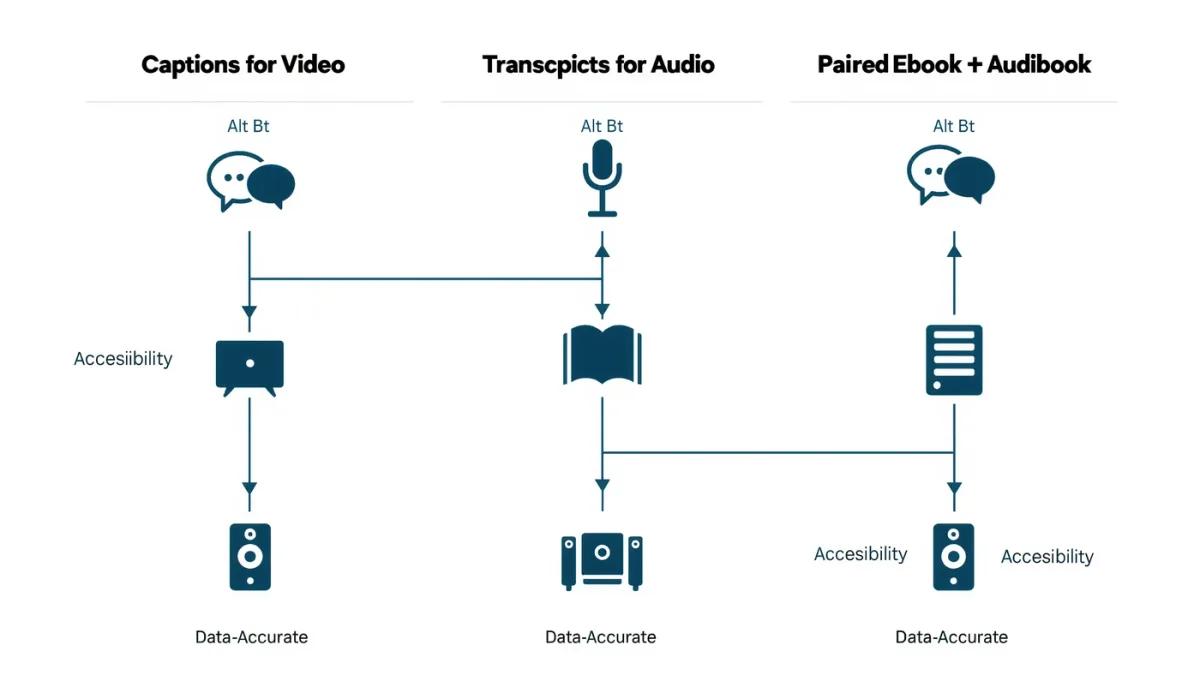
For deaf and hard-of-hearing readers, the accessible version of spoken content is text: captions on video, transcripts for podcasts and audio, and synced text alongside audiobooks where a platform offers it. The benchmark is the WCAG requirement that prerecorded audio content have captions and a text alternative, published by the W3C (2023). The ebook world has largely delivered on readable text — that is the medium's native form — while audiobooks and book-adjacent audio remain patchy on transcripts.
Why is text the accessibility answer for audio?
Hearing accessibility in reading is simpler to state than to find: any spoken product needs a written equivalent. The W3C's Web Content Accessibility Guidelines set the norm for the web — captions for prerecorded synchronized media and text alternatives for audio-only media — and that standard shapes expectations everywhere else, per the W3C's guidelines.
Ebooks are already on the right side of this line. A reflowable EPUB is text, so deaf readers get the full product by default. The accessibility question concentrates in the material wrapped around books: author interviews, book podcasts, promotional videos, audiobook samplers, and audio-original productions — the fastest-growing corner of the market, and the one where deaf readers can be quietly locked out.
There is also a middle population worth naming: hard-of-hearing readers who use audio with support — captions while watching, transcripts to fill gaps their hearing misses, or reading along while listening, which many people find improves comprehension regardless of hearing level.
What do audiobook platforms actually offer?
An honest inventory, per the platforms' published documentation:
- Text editions alongside audio. The reliable pattern is buying or borrowing the ebook with the audiobook; reading the text while audio plays gives a synced-words experience on platforms that highlight text in sync with narration where offered.
- Whispersync-style syncing. Some ecosystems pair an ebook and audiobook so the text position follows the narration, per Amazon's feature documentation. It is a commercial feature, not an accessibility program, but it functions as one.
- Captions on book video. Platform trailers and interviews caption inconsistently; where automatic captions exist, their accuracy varies, and WCAG notes that accurate captioning is what counts.
- Transcripts for audio-originals. Rare. Many audio-only originals have no published transcript, which is a genuine gap: a story sold with no text form at all is a story some readers cannot buy.
That last point is where advocacy lands. Producing a transcript of a ten-hour audiobook costs real money, but publishing without one excludes deaf readers from a product that exists only in their excluded modality. Some publishers do publish transcripts; asking before buying is reasonable, and requesting one is legitimate market pressure.
How do captions and transcripts compare in practice?
| Feature | Captions | Transcript |
|---|---|---|
| Best for | Synchronized video and film | Audio-only media, podcasts |
| Timing | Synced to the audio | Static document |
| Includes sound cues | Yes, well-made captions do | Only if written in |
| Searchability | Limited | Full text search |
| Standard | WCAG requires for video | WCAG requires as text alternative |
For a deaf reader evaluating a podcast or author interview, the transcript is usually the more useful artifact: it can be searched, read at any pace, and read on an e-ink device. For video, captions are the only thing that works in the moment.
What can deaf readers and publishers each do?
For readers, a few practical moves:
- Prefer text-first formats. Ebooks give you everything by default; spend your money there when the choice exists.
- Check for transcripts before paying for audio-originals. Publisher pages sometimes list them; if not, email and ask.
- Use caption settings aggressively. Adjustable caption size and contrast make hours of captioned video sustainable; the defaults are small.
For authors and small publishers, the checklist is short: caption every video you post, publish transcripts of podcast appearances, and if you release audio-only work, release the text with it. Each item is an hour or two of work per piece of content, and each one converts an inaccessible product into an accessible one.
Reading along also has a fatigue dimension. Hours of caption-watching is work; a transcript you read at your own pace, on an e-ink device with your preferred font size, lets you rest your eyes from video entirely. Many deaf readers report skimming a transcript first, then watching only the segments that need the visual context — a workflow that costs publishers nothing once the transcript exists.
Does the law require any of this?
In the United States, the Americans with Disabilities Act's effective-communication expectation has long driven captioning obligations for public entities and many businesses, per guidance from ada.gov, and court interpretations have increasingly treated online content as covered. In the EU, the European Accessibility Act, applying since June 2025, sets accessibility requirements across a range of products and services, which pushes the same direction. The details vary by country and by whether an exemption applies — small enterprises are treated differently in the EU framework — but the direction of travel is one-way: text alternatives are moving from courtesy to expectation.
Frequently asked questions
Do audiobooks have captions?
Generally no. Most audiobook apps do not offer full-text captions. The common workaround is pairing the ebook with the audiobook and reading along, which some ecosystems sync automatically as a commercial feature.
Are automatic captions good enough?
Sometimes, but not reliably. Accuracy varies widely with speaker, accent, and audio quality. WCAG treats caption quality as part of the requirement, so for anything you publish, review and correct automatic captions.
Where do I find books in sign language?
Signed storytelling exists mainly in children's content and specific programs from libraries and deaf organizations; availability varies by country and sign language. For general trade books, text remains the primary accessible route for deaf readers.
For more context, read What Should You Check Before Buying An Accessible E-Reader?.
For more context, read wcag for epub.
For more context, read How Do Students Get Accessible Textbooks?.